
AI is already reshaping how organisations operate, but is HR ready to lead the change?
In episode 4, series 4 of The Strategic Leader Podcast, we spoke with Naureen Hussain about the role HR can (and must) play in AI adoption. Not just as a stakeholder, but as a strategic guide helping to shape how AI supports people, culture and performance.
Naureen brings a rare blend of legal, strategic and operational expertise to the evolving world of AI and people strategy. With a background spanning employment law, data governance and responsible AI, she’s worked with HR leaders across sectors to align innovation with trust.
One of my key takeaways? We need a people first process that HR teams can actually follow. Something simple, structured, and rooted in real priorities not just hype.
After speaking with Naureen Hussain, a leading voice in responsible AI, I’ve summarised her advice into a practical process HR leaders can use as a starting point. The STRIVE model brings together the steps that matter most – strategy, trust, people and pace, in a way that’s clear and manageable.
The STRIVE Process for HR and AI Readiness
Each step in STRIVE is designed to help HR leaders move from reactive to strategic, with clarity, confidence and a focus on people at every stage.
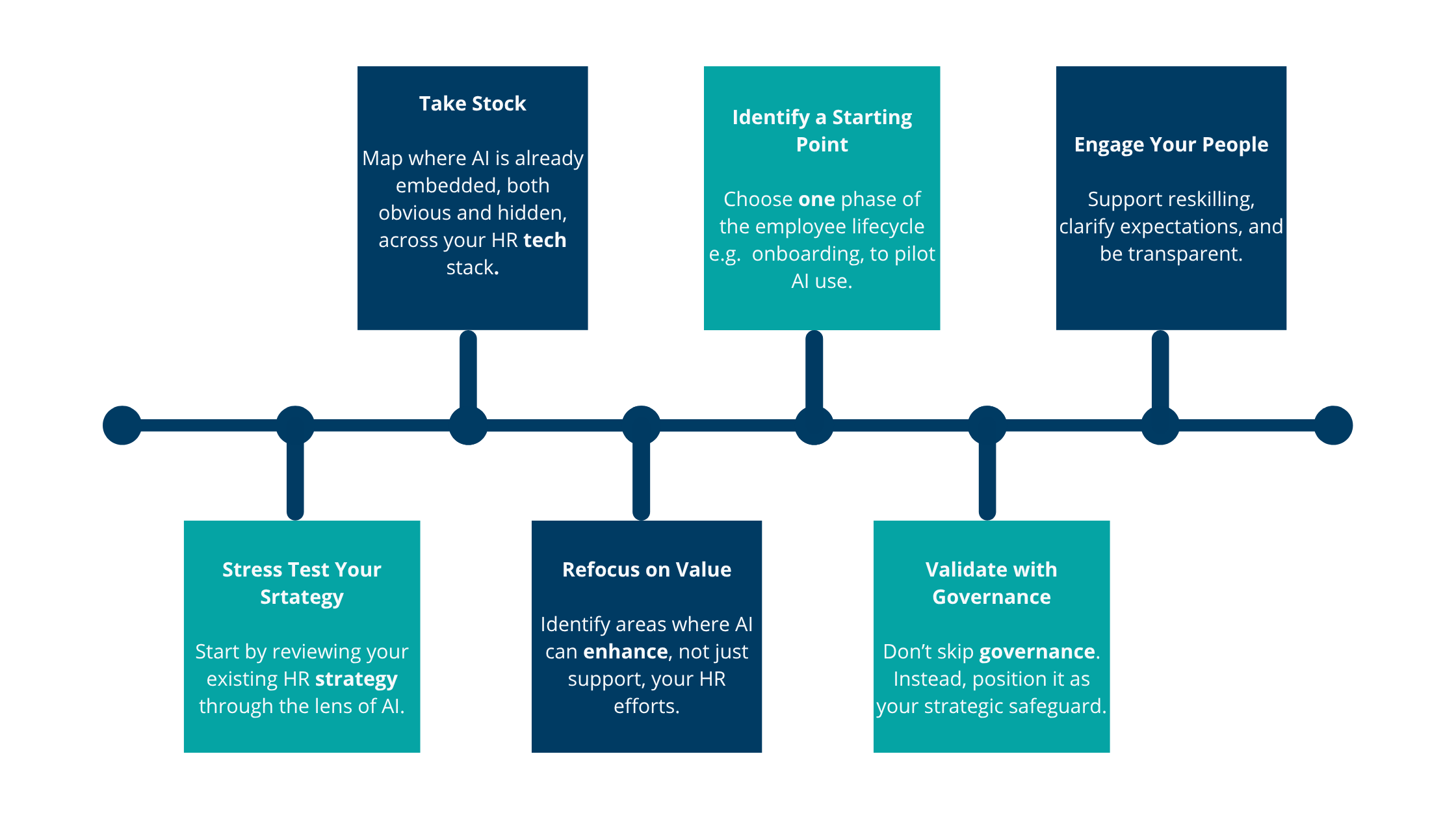
S – Stress Test Your Strategy
Start by revisiting your existing HR strategy. Ask yourself:
- Is it still relevant in the context of AI?
- Does it align with your organisation’s emerging AI plans?
- Have you considered where roles, skills or structures might evolve?
Naureen made a brilliant point, AI shouldn’t be something that sits in a silo. It should influence how we think about talent, design, and capability across the whole employee lifecycle. So begin by holding your strategy up to the light and updating it where needed.
T – Take Stock of Existing Tech
You might already be using AI without realising it. That’s why this step is all about visibility.
Look across your HR systems: recruitment, engagement, feedback tools, learning platforms. Where is AI embedded, even subtly?
Understanding your current landscape is key to identifying both risk and opportunity. Transparency matters here, for compliance, for trust, and for better decision-making.
R – Refocus on Value
Don’t let the tech lead the conversation. Instead, focus on impact.
- What problems are you trying to solve?
- Where could AI enhance your work, not just replace it?
- How can it add value for people, not just processes?
Whether that’s faster hiring, better DEI insights, or freeing up time for more human conversations, look for areas where the payoff is clear and tangible.
I – Identify a Starting Point
This is where the process becomes practical.
Pick one phase of the employee lifecycle to explore AI. It might be recruitment, onboarding, or learning. A narrow focus gives you a clearer test case, quicker feedback, and a better story to build on.
As Naureen said, trying to solve everything at once creates noise. Starting small helps you move with purpose.
V – Validate with Governance
AI and governance aren’t opposing forces. Governance is what enables confident, responsible adoption.
Make sure your process includes:
- Clear decision-making criteria
- Oversight from the right teams (legal, compliance, DEI)
- Transparent communication around how AI is used
Trust is earned. And strong governance helps you build it from the start.
E – Engage Your People
Last but never least: people. Technology adoption lives or dies by how well people understand, accept and engage with it. So ask yourself:
- How are we preparing our people for change?
- Are we offering reskilling, not just reassurances?
- Are we creating safety, not just structure?
As we discussed on the podcast, people need to feel part of the journey, not just subject to it. And that requires clarity, support, and inclusion at every step.
HR’s Real Opportunity
This process isn’t about ticking boxes or rushing into implementation. It’s about thinking more strategically and putting people at the heart of how AI is adopted.
Yes, the tech matters. But mindset, culture and trust matter more. The cost of delay? Missed opportunities and increased risk. The challenge now is to act with intention and to actually start. To learn more, listen to the full episode of the podcast, where Fi, Naureen and I discuss these practical actions.
If you’re starting to explore what AI readiness means in your organisation, this process is a helpful place to begin. And if you’d like a sounding board, whether on your HR strategy, or how to bring your people with you, I’m always happy to talk it through.
For deeper support on responsible AI adoption, governance or integration, I’d wholeheartedly recommend connecting with Naureen – her expertise is second to none.