
HR is often caught between two identities, the operational “doer” and the strategic “enabler.” In 2026, my hope is that more HR leaders feel able to step fully into the latter.
With the EU Pay Transparency Directive approaching, AI accelerating faster than organisations can absorb, and employee expectations continuing to evolve, 2026 offers a rare opportunity to reset.
So rather than predicting what will happen next year, here’s my festive wishlist of what I hope we will see more HR teams embracing, the shifts that would make the biggest difference for people, performance and culture.
1. A Shift from Performance Management to Performance Enablement
Performance management has long been the corporate chore everyone loves to hate, often more about paperwork than progress. If I could grant HR one wish for 2026, it would be that we finally stop obsessing over “managing” performance and instead invest in enabling it.
We need to see a stronger focus on defining what high performance actually looks like and how to build it, not just measure it. The conversation is shifting from retrospective appraisal to proactive growth.
Leaders may take some persuading on this – especially those obsessing about productivity and back-to-office mandates. But we need to stand firm.
Forward looking HR leaders will start to reframe performance management as a tool to build skills and future capability, not just reward or judge past effort.
My performance framework breaks this down into four component parts – skills, behaviours, effort, and outputs. By separating these elements, HR can better identify what drives success and how to develop it.
- Skills – What technical and interpersonal abilities underpin success?
- Behaviours – How are values lived out in daily actions?
- Effort – Are they working hard?
- Outputs – What measurable results are being delivered?
And overarching all of these – FOCUS. Are these skills, behaviours, effort, and outputs delivering what truly matters to the organisation?
When these are clearly defined, performance frameworks become far more credible and can be linked transparently to reward, capability building, and culture.
This shift could finally make performance management a meaningful driver of both employee engagement and organisational agility.




2. Pay Transparency Will Redefine Trust and Culture
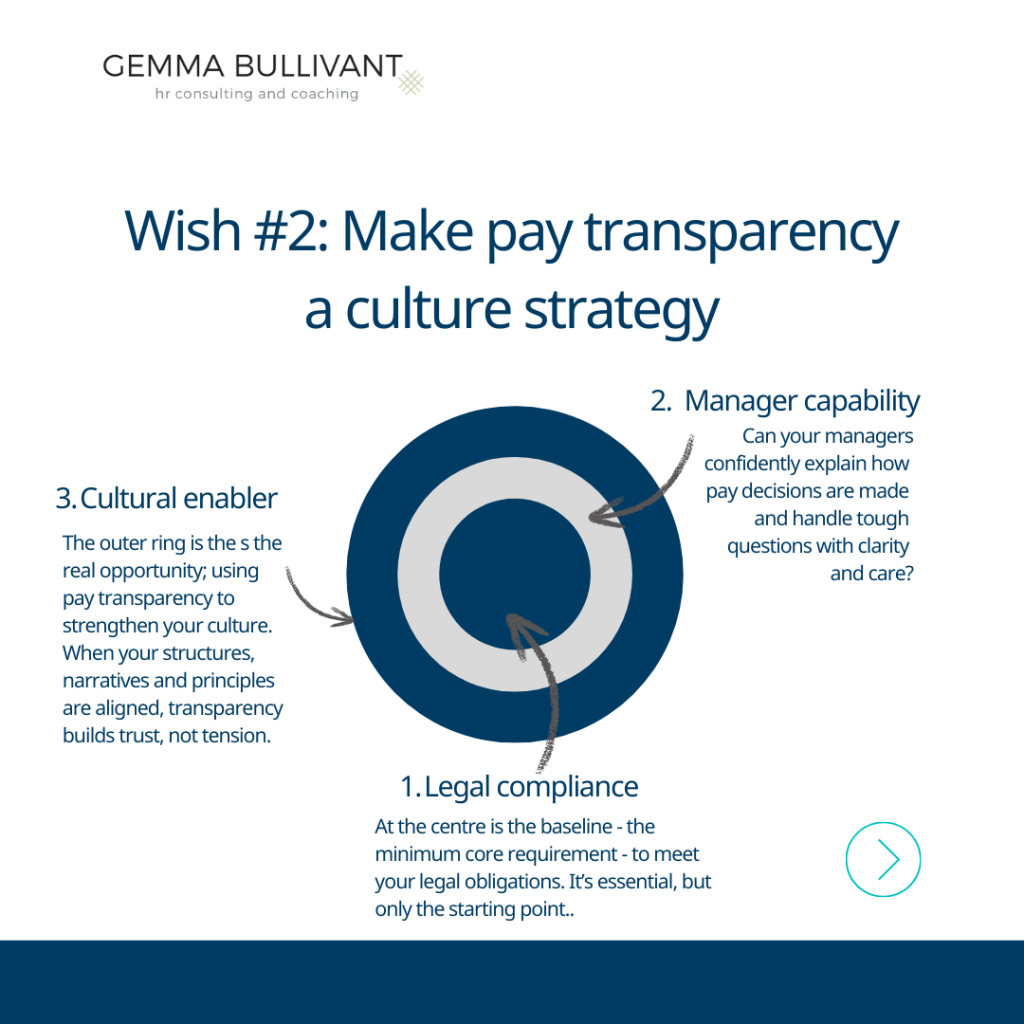
By June 2026, the EU Pay Transparency Directive will be live and it will be a game changer. But the real impact won’t be in legal compliance; it will be in cultural transformation.
Pay transparency isn’t about publishing data, it’s about being ready to tell the story behind it.
Organisations that treat pay transparency as a reporting exercise will miss the point. The leaders who approach it as an opportunity to rebuild trust, demonstrate fairness, and strengthen employee value propositions will set themselves apart.
Pay transparency will force HR to answer deeper questions:
- Do our pay decisions reflect fairness and consistency?
- Can our managers confidently explain how pay is determined?
- Does our reward strategy reflect the values we talk about?
The organisations that thrive will embed transparency into their reward strategy, communication and leadership capability. This isn’t just good governance, it’s the foundation of culture and trust.
3. AI Will Empower HR – Led by People, Not Platforms
AI has already changed how HR collects and interprets data, but in 2026 my third wish is that we resist the temptation to let it lead us.
Automation can help streamline processes like analytics, policy writing and insights generation, freeing HR to focus on higher value, people centred work.
The real opportunity lies in using AI to enhance human judgment, not replace it. As explored in Episode 4, Series 4 of The Strategic Leader Podcast with Naureen Hussain, HR’s role is to lead AI adoption responsibly, guiding how technology supports people, culture and performance.
AI can accelerate insight, but only humans can make it meaningful. HR’s role is to bridge the gap using technology to inform decisions, not make them.
AI is facing into a potential burst bubble, if the CEO of Google is to be believed. It will certainly stay, but it needs careful adoption and management. It still lacks context, culture and connection. It can identify trends but not interpret what they mean for real people. The HR professionals who combine data literacy with empathy and ethical judgment will become invaluable.
As AI becomes common, human insight becomes the differentiator that defines exceptional HR leadership and approach.
4. Total Reward Strategy Evolving into Total EVP
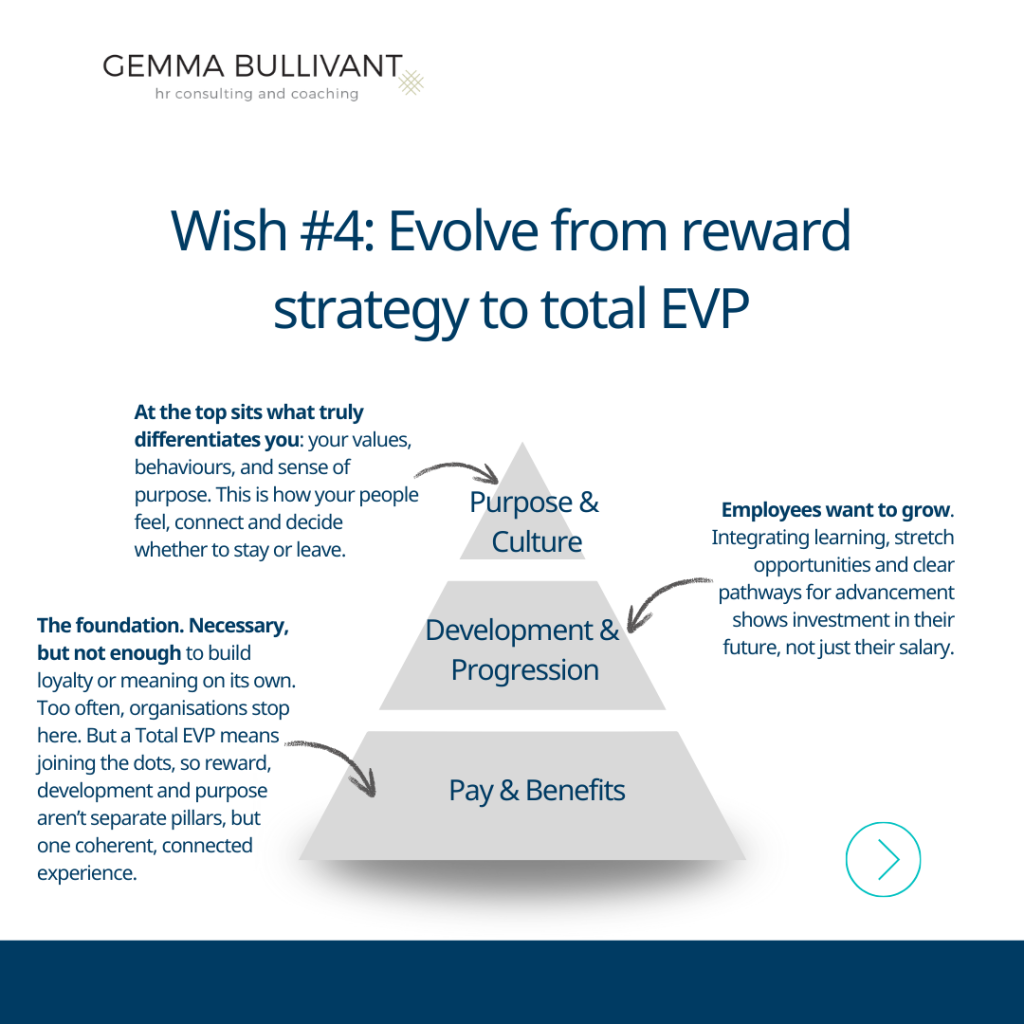
Reward used to be about pay. Later it widened into Total Reward, attempting to capture the broader employee experience and EVP, yet often defaulting to glossy statements and initiatives, rather than meaningful integrated change. In 2026, the focus needs to move towards a Total EVP. This is about creating an employee experience that feels fair, transparent, and genuinely connected to purpose, and linked to the reward framework.
Employees no longer separate pay from wellbeing, flexibility, or recognition. They judge fairness by how consistently they’re treated and how clearly the organisation communicates value.
Forward thinking organisations will integrate reward, development, and wellbeing into one unified framework. This means connecting pay structures with progression pathways, performance expectations, and growth opportunities.
Reward strategy is no longer just about market competitiveness, it’s about alignment, linking pay to purpose and behaviour, not just output.
The HR and reward leaders of 2026 will take a truly strategic Total Reward view, ensuring every aspect of pay, recognition and development reinforces the culture and goals of the business as one unified system, not a set of standalone initiatives.
5. Leadership Development Will Focus on Emotional Agility
If 2020–2025 was about resilience, 2026 will need to be about emotional agility – the ability for leaders to adapt quickly, stay grounded under pressure, and lead with clarity through ambiguity.
Organisational change, AI integration and pay transparency will all test leadership capability in new ways. HR’s challenge will be to help leaders develop the awareness and adaptability to manage emotionally charged environments with confidence.
Leadership development in 2026 should focus less on “training managers” and more on enabling leaders, giving them tools to think clearly, communicate openly, and model emotional intelligence at scale.
Rather than one-off leadership training, I’d love to see organisations invest in:
- Real-time support for leaders navigating change
- Capability-building beyond resilience
- Better role-modelling of emotional intelligence
- Coaching that helps leaders think clearly under pressure
6. From Process Custodian to Culture Shaper
HR’s greatest opportunity in 2026 will be to move from reactive governance to proactive enablement. My wish is that more HR teams consciously progress along the maturity journey, moving from reactive responses to proactive systems, and ultimately to transformational leadership that shapes culture, rather than simply supporting it.
Instead of reacting to disruption, I hope more HR teams will design the systems that help people thrive through it, whether that’s transparent reward, change ready performance frameworks, or leadership capability that anchors wellbeing and accountability.
This shift reflects a broader trend we explored in The Strategic Leader Podcast, “How to Be a More Strategic HR Leader” and “Is It Time to Redefine Performance?”. Both highlight how HR must evolve from enforcing processes to enabling strategy and building influence through insight, not instruction.
As organisations face constant transformation, this proactive stance will become the defining hallmark of high impact HR. The leaders who embrace it will turn change from a risk into a strategic advantage.


Enablement Is the New Management
If there’s one theme that runs through this entire wishlist, it’s that enablement is the new management.
The future of HR isn’t about controlling processes; it’s about creating the conditions where people can perform, adapt, and thrive.
Enablement means redefining success not as compliance or control, but as capability. Building systems, skills and confidence that sustain performance through uncertainty.
When HR leads with enablement, it doesn’t just manage people, it empowers them and that’s how organisations will grow in 2026 and beyond.