
The more senior you become, the more perspectives you are expected to hold at the same time.
You may have your own view of a situation, but you also need to understand what matters to your team, what other functions are trying to achieve, what your stakeholders expect and, ultimately, what the wider business needs.
It is one of the reasons strategic leadership can feel so different from being an expert in your own area. Your value is no longer simply in knowing your subject; increasingly, it comes from your ability to zoom out, see the wider picture and bring different perspectives together.
Perspective shifting is more than empathy
Most of us are familiar with empathy – the ability to put ourselves in somebody else’s shoes and consider how they might be feeling.
Perspective shifting takes that idea in a slightly different direction. Rather than emotional agility, we can think of it as intellectual agility – temporarily stepping outside our own way of thinking to consider somebody else’s priorities, assumptions, motivations or view of the situation.
We all have preferred ways of seeing the world; our experience, role, personality and expertise influence what we notice and what we prioritise, which means two perfectly capable people can look at exactly the same problem and see something very different.
The skill isn’t in deciding whose perspective is right, it is being able to move between them without becoming so attached to your own that you develop tunnel vision.
Strategic breadth means seeing beyond your own function
This becomes particularly important as you move into more senior leadership roles, because you’re increasingly expected to represent the interests of the whole organisation rather than simply advocate for your own area.
I was recently coaching someone who was developing a strategy and had done an excellent job of understanding what employees wanted. She could clearly articulate the employee sentiment, the needs coming through in surveys and the challenges people were experiencing, but she was struggling to get senior-level engagement with what she was proposing.
So we changed the perspective.
Rather than looking only from the bottom up at what employees needed, I encouraged her to look from the top down at what the business was trying to achieve. How did addressing those employee needs contribute to the wider objectives? Where did the two meet?
The employee perspective wasn’t wrong, nor did it become less important. But adding the business perspective made the strategy stronger and helped move the conversation from “this is what our people are asking for” to “this is why solving this problem matters to the organisation.”
That ability to move between perspectives is an important part of strategic breadth.
What would your stakeholders say about you?
Stakeholder management is another area where this becomes particularly useful, because it is easy to think we understand our stakeholders without ever really stepping into their perspective.
In the podcast Fi suggests we start by identifying who our stakeholders actually are and then asking two deceptively simple questions:
What are they currently saying about us?
And then:
What does the business need them to be saying about us?
Fi described working with a team who believed an important stakeholder community would say that they cared, were supportive and were trying to do the right thing. Initially, that sounded positive.
But when the team considered what that stakeholder actually needed from them in the context of the organisation’s strategy, the answer was quite different. They needed the team to be seen as people who drove change and made things happen.
Perspective shifting exposed the gap between how the team believed they were showing up and what their stakeholders actually needed from them.
Want to explore this further? Listen to Series 6, Episode 6 of The Strategic Leader Podcast, where Fi and I explore practical ways to shift perspective and see challenges through a different lens.
Deliberately look at the problem differently
Sometimes we need a little structure to force ourselves out of our default perspective.
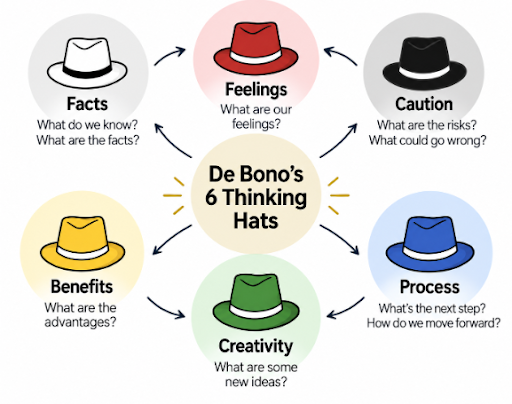
Edward de Bono’s Six Thinking Hats, for example, deliberately asks us to look at the same situation through different lenses, including facts, emotions, opportunities, risks and creativity. The value is giving ourselves permission to stop defending our preferred way of thinking and explore another one.
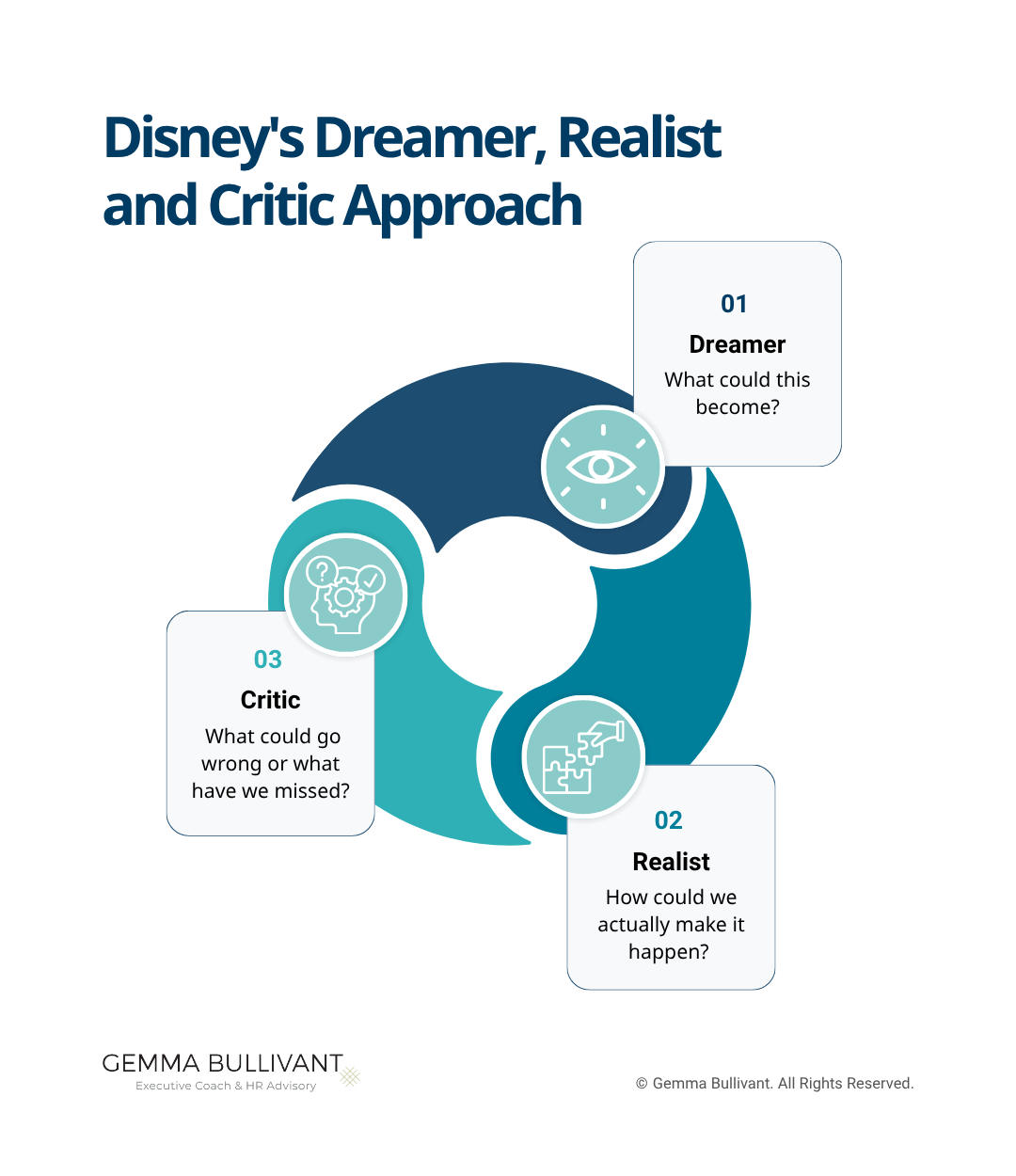
Another example we discussed is Disney’s Dreamer, Realist and Critic approach. An idea is explored first from the perspective of the Dreamer – what could this become? – before moving to the Realist – how could we actually make it happen? – and finally the Critic – what could go wrong or what have we missed?
If you don’t have the time, space or inclination, you don’t need multiple rooms or a formal workshop to apply the principle. Simply noticing which of those perspectives comes most naturally to you, and deliberately spending time in the others, can improve the quality of your thinking.
Use perspective shifting when you’re stuck
Perspective shifting can also be useful on a much more personal level, and it is something I regularly use in coaching.
When somebody is caught up in a difficult situation, one of the simplest questions I can ask is:
Very often, they know immediately.
They haven’t suddenly acquired new information. What has changed is their perceptual position.
Instead of being the person caught in the middle of the situation, they have temporarily become the leader looking at it from the outside, which can give them access to ideas they were struggling to see before.
The same principle can help us navigate conflict. Understanding why somebody might be behaving in a particular way doesn’t mean excusing poor behaviour or agreeing with them, but considering the pressures, priorities or motivations influencing their perspective can help us decide how best to respond. And there’s a self-awareness piece here too. Before we can genuinely explore somebody else’s perspective, we need to recognise the assumptions, preferences and reactions we’re bringing to the situation ourselves – something we explore further in Episode 5: How to Build Self-Awareness to Become a More Effective Leader.
Strategic leaders need to move between perspectives
The ability to step outside your own perspective is often easier in theory than in practice, particularly when you’re close to the problem.
Whether you’re developing strategy, navigating conflict, managing stakeholders or deciding where competing priorities should sit, the ability to zoom in, zoom out and look again from somewhere else can reveal information that wasn’t available from your original position.
Executive and leadership coaching creates the space to step back from the day to day, challenge your thinking and explore situations from different perspectives, helping you build greater strategic confidence and make more intentional leadership decisions.