
AI can draft the proposal, summarise the meeting, analyse the data and produce a beautifully structured document in seconds. It can give us ten ideas when we only had two, challenge an assumption we hadn’t spotted and help us make sense of a page full of thoughts that haven’t quite formed into anything useful yet.
There is a lot to like.
But there is also a risk that, somewhere in our enthusiasm to get to the answer faster, we start outsourcing something we really shouldn’t: the thinking that needs to happen before and after the answer arrives.
In Series 6, Episode 7 of The Strategic Leader Podcast, Fi and I explore critical thinking as the next tool in our Strategic Leader Toolkit and why, in an age where plausible, polished answers are available almost instantly, our ability to question, challenge and exercise our own judgement may be becoming more important rather than less.
The real skill is being able to decide what deserves our attention, what we believe, why we believe it and whether the answer in front of us actually solves the problem we started with.
What is critical thinking in leadership?
Critical thinking is the ability to actively question and evaluate information rather than accepting it at face value.
During the podcast, we refer to an Oxford Brookes University definition that prompts two simple questions:
What do I think about this? And why do I think it?
Critical thinking is being able to examine the information in front of you, understand the assumptions sitting behind it, compare it with other evidence and arrive at a judgement you can explain.
The more senior we become as leaders, the less likely we are to face problems with one obvious, objectively right answer. Instead, we are making decisions with incomplete information, competing stakeholder needs and commercial pressures, often without knowing the full consequences until months or even years later.
Good critical thinking as a leader therefore requires us to resist the urge to race straight towards a solution and spend enough time understanding what we are actually trying to solve.
And that is where AI makes things particularly interesting.
The danger of getting to the answer too quickly
We’ve talked many times on the podcast about a simple framework I use in my coaching and strategic work:
What? > So What? > Now What?
Human beings have a natural pull towards the ‘now what?’ We like action, progress and solving things, and AI makes that pull even stronger because we can now ask AI for a Reward strategy, Board proposal or organisational model before we’ve really completed the thinking that should inform it.
Within seconds, something impressive appears on the screen. But have we clearly defined the problem? What are we trying to change? What would a good outcome look like? What evidence and constraints need to be considered?
We might have a speedy answer, but we’re not entirely sure whether it answers the right question.
Six critical thinking skills leaders need to keep practising
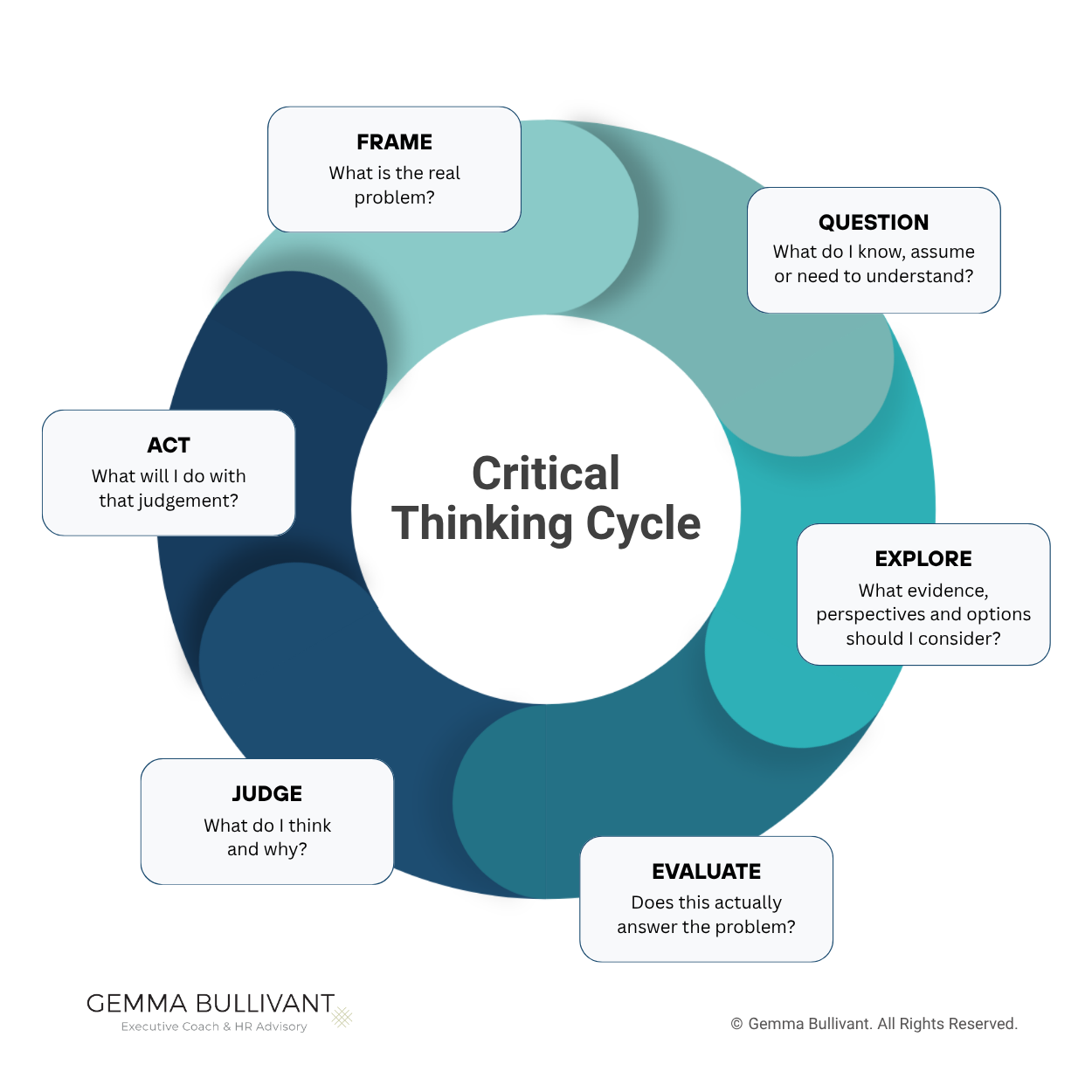
The Critical Thinking Cycle gives us a useful way to slow the journey from problem to action, but what does that look like in practice? Expanding on the stages, there are six critical thinking skills leaders can keep practising, particularly when making greater use of AI.
1. Frame: Start with the real problem
Before opening an AI tool, writing the paper or calling the meeting, take a moment to define what you are actually trying to solve. What are we trying to achieve? Why does it matter? What would a good outcome look like?
2. Question: What do I know, assume or need to understand?
Ask yourself what facts do you already know, what you have inferred and what you are simply assuming to be true. This is particularly important with AI, where a confidently presented answer can make assumptions much harder to spot.
3. Explore: What evidence, perspectives and options should I consider?
Critical thinking shouldn’t just help us build a better argument for something we’ve already decided. When seeking evidence, deliberately ask what might prove you wrong, what alternative explanations exist and what somebody with a different perspective might see.
4. Evaluate: Does this actually answer the problem?
Come back to the problem you framed at the beginning. A proposal cannot meaningfully be described as “good” without criteria. Good for whom? Against which objective? At what cost? With what risks? Agreeing what success looks like before evaluating the options makes judgement considerably stronger.
A polished solution isn’t necessarily a useful one if it doesn’t move us closer to the outcome we originally set out to achieve.
5. Judge: Decide what you think and why
Eventually, critical thinking requires human judgement. We need to OWN the content we have created with the help of AI – we need to be clear on why WE have chosen to include this content, and why. We need to look beyond the seductively polished written document and engage with what it is saying, and what it means.
Whether the analysis has come from AI, your team or your own research, you still need to be able to explain the reasoning behind it. The document is the vehicle for your thinking.
6. Act: What will I do with that judgement?
Make sure you can stand behind the decision. Before acting, ask yourself whether you understand the recommendation well enough to explain it, defend it and take responsibility for what happens next.
My takeaway? – AI can support us at every stage of this cycle, helping us explore possibilities, challenge assumptions or test our reasoning, but it shouldn’t remove our responsibility to move through those stages ourselves.
Are we spending more time “botsitting” than thinking?
Lifting up for a moment to consider the wider organisational impact of AI on working practices the 2026 Work AI Index from the Work AI Institute is a sobering read. It paints a fascinating picture of how AI is changing work.
Of the 87% of digital workers who use AI at work, 75% say it makes them more productive, whereas only 13% say their organisation is performing significantly better as a result. Workers estimate that automation saves them around 11 hours each week, so why is this improvement not being felt at an organisational level? The researchers also found that an average 6.4 hours a week is spent “botsitting” – feeding AI context, supervising outputs, debugging mistakes and cleaning up what it produces.
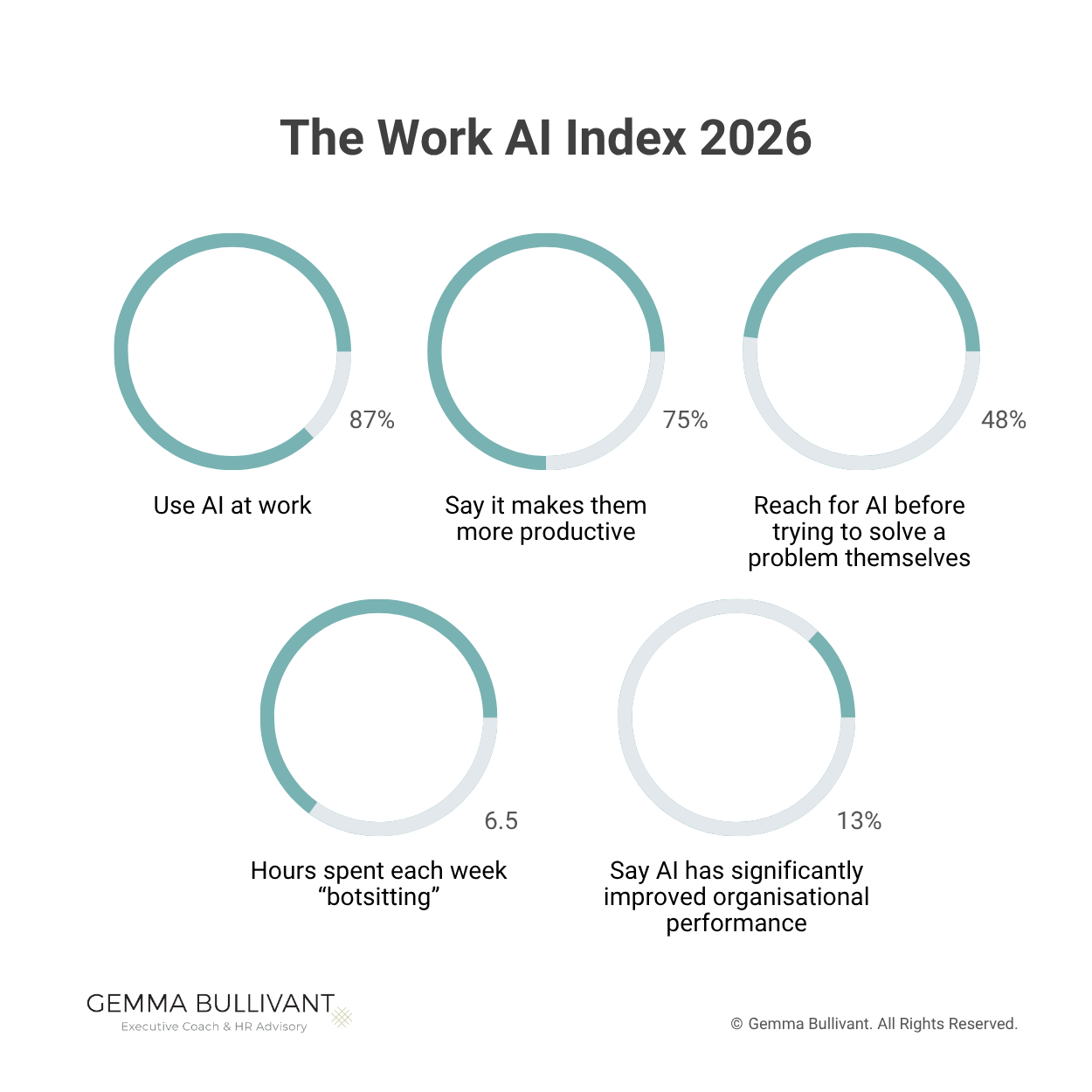
The report also found that one of the biggest capability gaps between high and low AI achievers was knowing when not to use AI: 89% of high AI achievers said they could do this, compared with 68% of low AI achievers. This suggests another crucial role for critical discernment – knowing when to use AI, and when to defer to alternative approaches.
That feels much closer to the leadership capability we should be developing – discernment rather than dependence.
Create space to think
As the volume of information, analysis and AI-generated content around us increases, the premium shifts towards our ability to make sense of it. Leaders will need to know when to question, when to investigate further, when to trust their expertise, when to seek another perspective and, increasingly, when not to use AI at all.
So, the next time a beautifully written answer appears on your screen, resist the urge to immediately hit send and ask yourself two questions first:
What do I think about this?
And why do I think it?
Those might be two of the most valuable critical thinking skills we can keep practising.
If you need some space to think through a leadership challenge, executive coaching can give you the time and perspective to explore what’s really going on before deciding what to do next.