
The latest Women in the Workplace report from McKinsey reinforces something I see consistently in executive coaching conversations; leadership is becoming more psychological, not more technical.
For many years, executive development focused heavily on capability expansion. Leaders were encouraged to deepen expertise, broaden commercial understanding and refine strategic thinking. The assumption was that success at senior levels came primarily from sharper analysis, stronger decision frameworks and deeper subject knowledge.
That thinking made sense in a world where knowledge itself was scarce.
But the environment leaders now operate in has changed. AI, automation and digital systems are rapidly reshaping how information is created, analysed and shared. Many tasks that once required deep expertise can now be supported or accelerated by technology. As a result, the differentiating capability of leadership is shifting.
Leadership is increasingly shifting toward judgement, interpretation and emotional intelligence. What differentiates leaders now is often the quality of the conversations they can hold, the steadiness they bring when things feel uncertain, and how thoughtfully they balance competing priorities.
Reframing “Soft Skills” as Human Skills
Capabilities such as communication, empathy and emotional intelligence are often described as “soft skills”, language that has perhaps unintentionally diminished their importance. In reality, what we are talking about are human skills.
The World Economic Forum’s Future of Jobs research consistently highlights capabilities such as resilience, adaptability, complex problem solving and emotional regulation as essential for the future of work. These are behavioural and psychological capabilities that shape how leaders interpret situations, work with others and make decisions under pressure.
Interestingly, the Women in the Workplace research suggests that many of these capabilities are already being exercised extensively inside organisations, often by women leaders. McKinsey reports that female leaders are significantly more likely than men to support employee wellbeing, mentor colleagues and invest time in diversity, equity and inclusion efforts. They are also more likely to step in to resolve team tensions or provide emotional support during periods of change.
Yet much of this work remains largely invisible in traditional performance systems.
At the same time, the report highlights a persistent leadership pipeline challenge; for roughly every 100 men promoted to manager, only around 93 women are promoted. In other words, many of the behaviours organisations rely on to maintain cohesion, trust and culture are not always the behaviours recognised in leadership progression.
What this suggests is that the skills we have historically labelled “soft” are not peripheral at all. They are core leadership capabilities in complex organisations. As work becomes more automated and information more abundant, the leaders who can hold difficult conversations, integrate different perspectives and maintain trust under pressure will increasingly become the ones organisations rely on most.
When Confidence Drops Before Capability
One of the more interesting insights from the Women in the Workplace research is that confidence and voice can decline before capability does.
Many female leaders report feeling less confident stepping into senior leadership roles, even when performance evidence clearly demonstrates their competence. In coaching conversations this pattern appears frequently. Leaders who are highly capable on paper may still question whether they truly belong in senior forums.
Leaders may begin to second-guess their contributions, over prepare for meetings or hesitate to challenge dominant voices in the room.
Executive coaching in these situations often focuses on strengthening executive confidence in a deeper way. Not confidence built purely on role or title, but confidence grounded in the belief that you can continue to generate value even as the context around you evolves.
This kind of confidence is more stable because it is rooted in identity rather than position.
Imposter Narratives in High Performance Environments
The concept of imposter syndrome originally emerged from research on high-achieving women. Over time the language has broadened significantly, sometimes losing the nuance of its origins.
In high-performance environments, particularly those shaped by constant digital comparison, it is easy for leaders to misinterpret normal developmental discomfort as inadequacy.
Curated success stories can create the impression that everyone else feels confident and certain. The difference lies in how that doubt is interpreted.
Leaders may respond in different ways:
- Hesitating to challenge dominant views
- Avoiding visibility or leadership opportunities
- Overworking to prove value
- Seeking constant external validation
- Deferring decisions unnecessarily
These are often responses to perceived expectations rather than genuine capability gaps. As we discussed in Season 2, Episode 1 of The Strategic Leader Podcast, overcoming imposter syndrome often begins with learning to separate the internal narrative from the evidence in front of you. Executive coaching frequently helps leaders pause, examine those assumptions and reconnect with their actual capability.
Staying Human is Your Leadership Advantage
In an increasingly automated world, the leaders who stand out are not necessarily those who adopt technology fastest, but those who remain most human in how they lead.
Human leadership means being able to work effectively within complex relational systems.
The best senior leaders increasingly spend their time:
- Navigating competing stakeholder priorities and expectations
- Managing organisational anxiety during change
- Facilitating difficult conversations
- Balancing performance expectations with wellbeing
- Making decisions in environments where certainty is impossible
These are deeply human challenges. The ability to regulate emotion, maintain perspective and communicate clearly becomes a significant leadership advantage.
But these leadership capabilities only matter if people feel able to contribute honestly within the system. The McKinsey research highlights a quieter leadership dynamic here. Women outside senior leadership are consistently less comfortable speaking up, disagreeing with others or taking risks at work.
For example, only around 62% of entry-level women report feeling safe to take risks and make mistakes, compared with more than 70% of men at the same level. Similar gaps appear when employees are asked whether they feel comfortable disagreeing with others.

This matters because psychological safety directly shapes whether capable people contribute their thinking in the moments that matter.
The report also reinforces something many leaders intuitively understand. When employees perceive their workplace as fair and inclusive, they are at least twice as likely to feel motivated to do their best work, take risks and speak up. They are also significantly less likely to experience burnout or consider leaving.
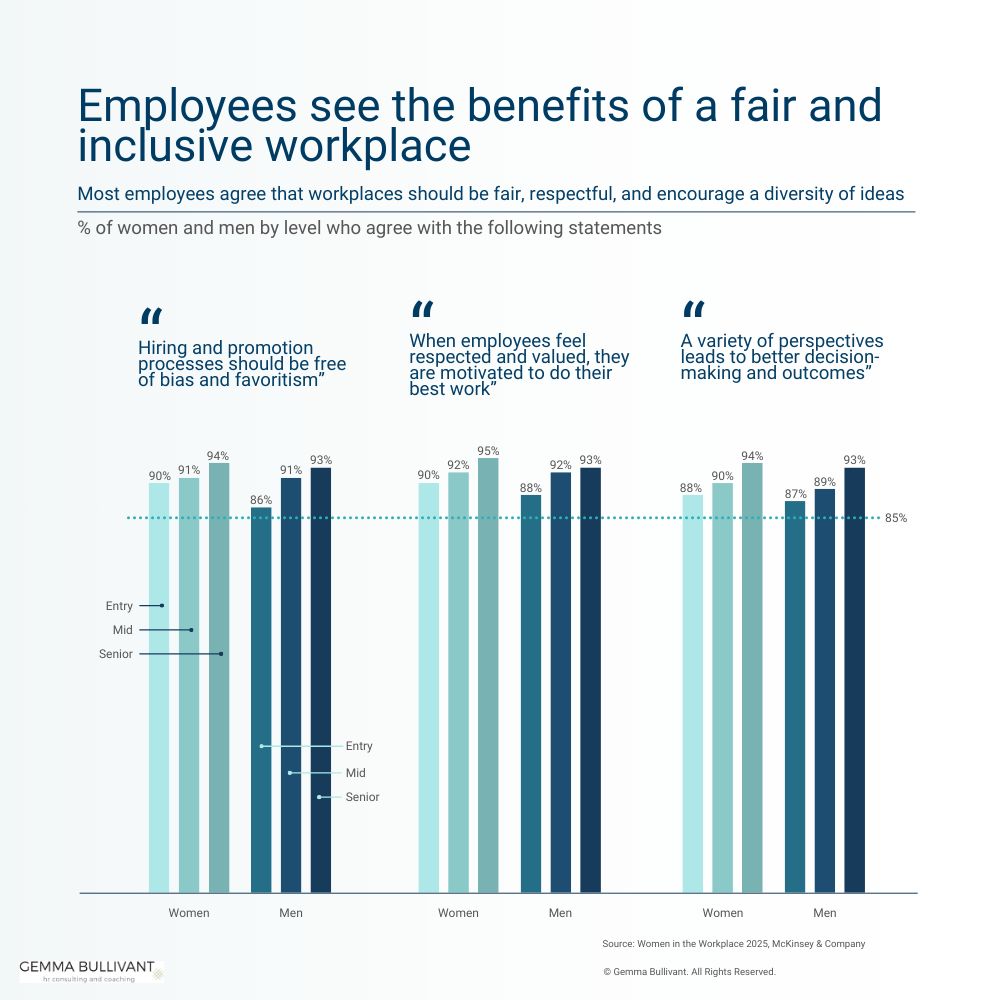
In other words, leadership behaviour directly influences whether organisations benefit from the full intelligence of the people within them.
That is why human leadership capability matters so much. The way leaders listen, challenge, support and respond to their teams ultimately determines whether people feel able to contribute fully.
What This Means for Executive Coaching
The themes emerging from the McKinsey research all point toward a broader shift in how leadership development must evolve; technical expertise remains important, but it is no longer sufficient on its own. Executive development increasingly needs to focus on strengthening psychological capability.
In coaching conversations, this often includes work around:
- Executive confidence and leadership identity
- Navigating complex stakeholder dynamics
- Managing pressure without losing strategic perspective
- Recognising and challenging internal narratives
- Developing a more grounded leadership presence
This kind of development is fundamentally about becoming more psychologically aware. Leaders who understand how their thinking patterns, beliefs and behaviours influence their leadership are better able to adapt in complex environments.
The Truth About the Future of Leadership
As automation increases, the uniquely human dimensions of leadership actually become more valuable.
Confidence, judgement, emotional intelligence and psychological awareness are no longer peripheral leadership qualities. They are becoming central to how effective executives operate.
For leaders navigating this environment, it is worth strengthening how you think, decide and relate to others.
Executive coaching creates the space to do that work deliberately.
Not to add more noise, but to build clarity, perspective and confidence in a world that rarely slows down long enough for reflection.