
Making decisions is one of the most important responsibilities of senior leadership. The further you progress in your career, the more likely you are to encounter decisions where there isn’t an obvious answer, the information is incomplete and the consequences could be significant.
Effective strategic decision making requires judgement, understanding the situation you’re facing and recognising what you need to make a decision.
In Series 6, Episode 9 of The Strategic Leader Podcast, Fi Craig and I explore some practical frameworks for navigating those difficult decisions, particularly when we’re dealing with uncertainty, competing priorities and balancing different perspectives.
What is strategic decision making?
Strategic decision making involves making choices that influence the longer-term direction, priorities and success of an organisation.
Think about decisions concerning organisational structure, investment, entering new markets or changing how a business operates. There may be several viable options, each with different risks and opportunities, and no guarantee that the option you choose will deliver the outcome you expect.
That’s what makes business decision making at a strategic level particularly challenging. You’re not simply choosing between right and wrong. You’re often choosing between different versions of what might be right.
Not every strategic decision needs the same approach
One framework that can be particularly useful is the Cynefin framework, developed by Dave Snowden. It’s a sense-making framework that helps us recognise different types of situations and consider how best to respond.
It identifies five domains:
- Clear: Straightforward situations where established processes and best practices provide a reliable answer. Think of an expenses policy or onboarding checklist.
- Complicated: Situations involving multiple components that require analysis or specialist expertise, but where cause and effect can still be understood. Implementing a new HR system might be an example.
- Complex: Situations where the relationship between cause and effect is uncertain and outcomes emerge over time. There may be several possible approaches, and we often only understand what worked with hindsight.
- Chaotic: Unpredictable situations requiring immediate action to establish some stability, such as the initial response to a serious cyberattack.
- Disorder: When we haven’t yet established which type of situation we’re dealing with, making it difficult to determine the right response.
Cynefin Framework
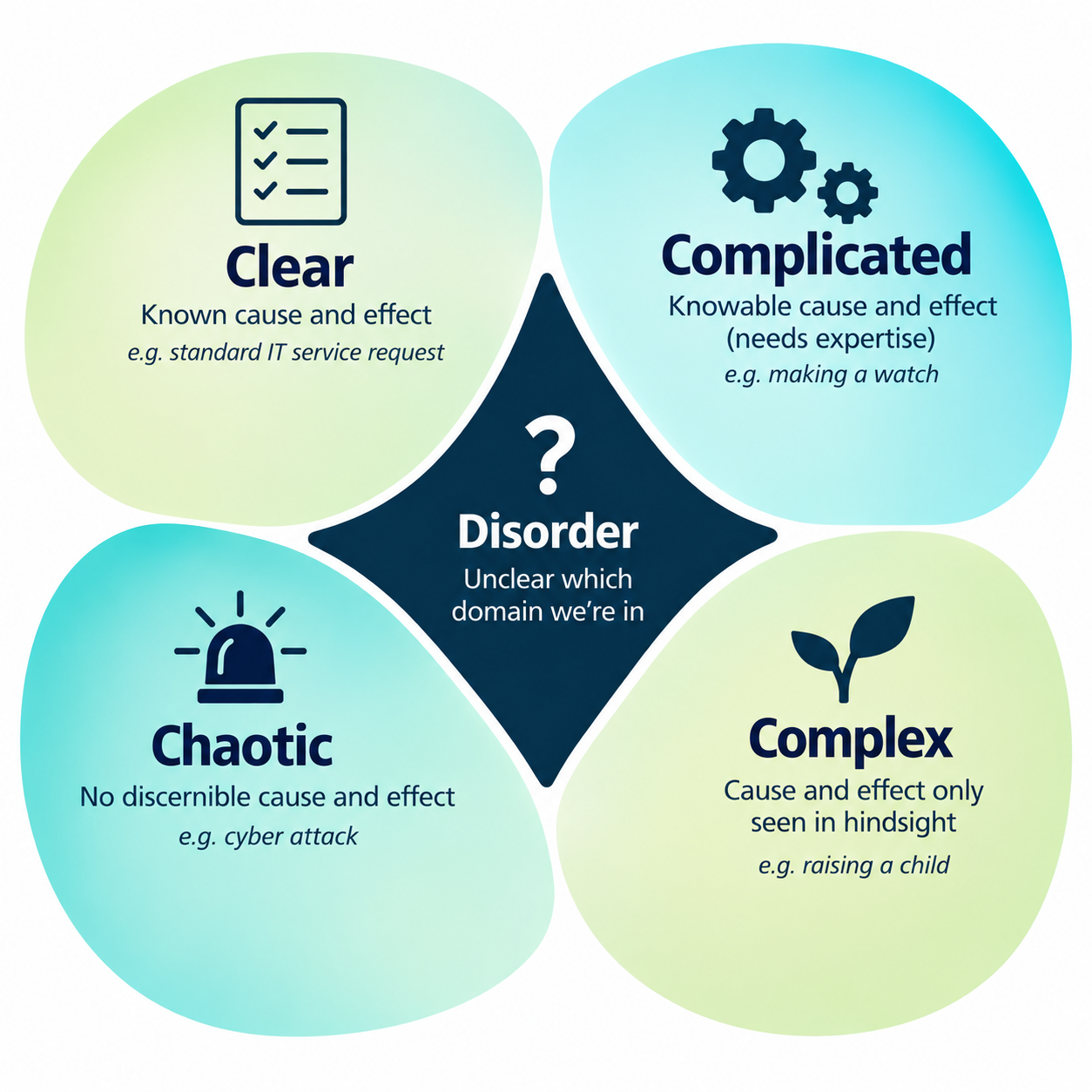
In the episode about strategic decision making, Fi offers a particularly helpful analogy for distinguishing between complicated and complex situations.
Building a watch is complicated. There are numerous components, specialist skills are required and getting everything working together takes expertise. But there is ultimately a way to establish whether you’ve got it right.
Raising a child, on the other hand, is complex. You make decisions based on your knowledge, experience and the circumstances in front of you, but there isn’t one prescribed route to success. What works in one situation may not work in another, and you might only recognise the impact of your decisions much later.
I think this distinction is particularly important in leadership because we sometimes approach complex problems as though they are merely complicated ones.
We keep analysing, gathering information and searching for the correct solution, when the nature of the challenge means we may need to experiment, observe what happens and adapt our approach.
Good strategic judgement begins with recognising which approach the situation actually needs.
How much information is enough to make a decision?
Many of us have this desire to keep gathering information until we feel certain.
There was a time when gathering and analysing information required considerable effort. Today, we have access to an almost endless supply of data, research, opinions and AI-generated analysis. There’s always another report we could read or another perspective we could explore.
The problem is that more information doesn’t automatically lead to better decisions.
At some point, we have to exercise judgement about which information is relevant, what we still need to understand and whether further analysis is genuinely likely to change our decision.
We often wait until we feel confident before taking action, when confidence can actually develop through the experience of acting, learning and adjusting. Rather than delaying the decision, we should recognise that certainty isn’t always available, particularly when we’re dealing with complex strategic challenges.
The cost of not making a decision
While we’re waiting for more information or another round of agreement, the organisation continues to move. Opportunities may pass, costs may increase and people can become frustrated.
In some situations, waiting is absolutely the right decision. But in others, the cost of delay may outweigh the value of having a little more certainty. This is where strategic judgement is again, particularly important.
What are we gaining by waiting, and what might we be losing?
It’s a useful question when you find yourself revisiting the same strategic options without making meaningful progress.
Who actually owns the decision?
Even when we’re clear about the type of decision we’re making, progress can stall if we’re not clear about who has the authority to make it. At senior leadership level, where decisions often involve multiple stakeholders and competing priorities, confusion about decision making roles can lead to delays, frustration and endless discussion.
One of the simplest frameworks for clarifying this is RACI, which identifies four roles:
- Responsible: The person or people carrying out the work.
- Accountable: The person who ultimately owns the outcome and has final accountability.
- Consulted: Those whose expertise or perspectives need to inform the decision.
- Informed: Those who need to know what has been decided.
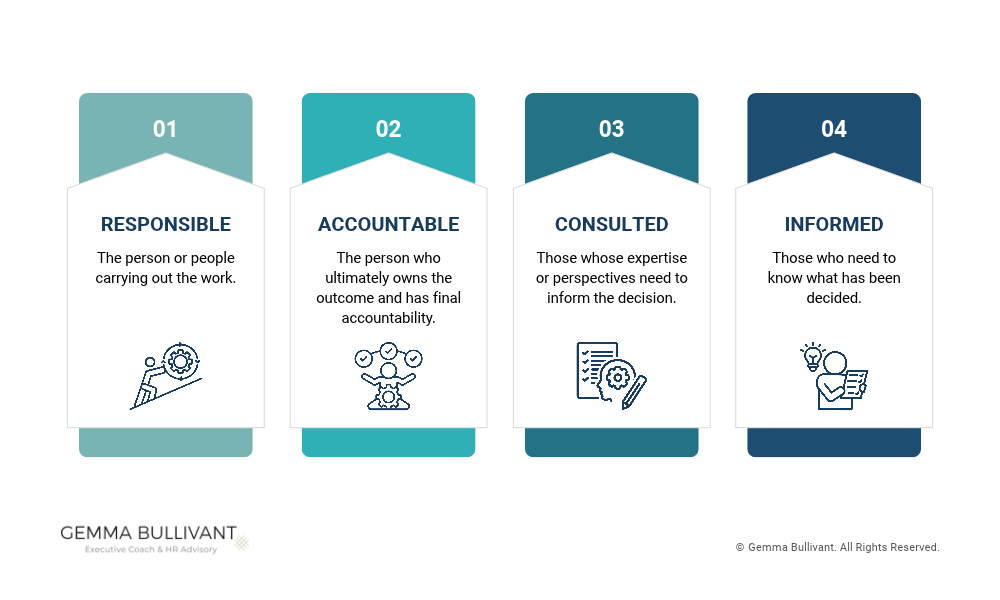
The distinction between responsible and accountable is particularly important. We can have several people contributing to the work, but for a decision requiring an individual owner, there needs to be clarity about who makes the final call.
In leadership teams, this can become surprisingly blurred. Several people may feel they should have a say, particularly when the decision affects different functions, budgets or priorities.
Before getting into the details of a difficult business decision, it is helpful to establish who needs to contribute, who needs to be consulted and who ultimately has the authority to decide.
How can leaders improve their strategic decision making?
The frameworks we’ve discussed are useful, but they don’t remove the need for judgement. They help us create the conditions in which better judgement becomes possible.
If you’re facing a difficult decision, it may be worth asking yourself a few questions before getting drawn into the detail:
- What kind of decision are we making? Is there an established answer, do we need expert analysis, or are we dealing with uncertainty that requires experimentation?
- What information is genuinely necessary? Are we gathering evidence that could change our decision, or simply delaying the moment we have to make it?
- Who owns the decision? Are the roles and responsibilities clear, particularly when several stakeholders are involved?
- Do we need consensus or consent? Must everybody agree on the preferred solution, or could we move forward with something that’s good enough and safe enough to try?
- What happens if we’re wrong? Can we learn and adapt, or are the consequences significant enough to justify a more cautious approach?
Good decisions don’t always mean getting it right
We can make a thoughtful, well-informed decision, involve the right people and consider the risks, only to discover later that the outcome isn’t what we’d hoped for. There will always be factors we couldn’t predict or control, particularly in complex situations.
What matters is whether we exercised sound judgement with the information available, understood the consequences and remained willing to learn and adapt.
Want to explore the ideas further? Listen to Series 6, Episode 9 of The Strategic Leader Podcast, where Fi Craig and I discuss the Cynefin framework, decision making ownership and how consent can help leadership teams move forward when agreement feels difficult to achieve.